What Should You Learn First If You Want to Become a Nail Tech?
If you want to become a nail tech, it is very easy to get overwhelmed before you even begin.
You open Instagram or TikTok and suddenly you are looking at perfect French tips, structured gel manicures, intricate nail art, extensions, chrome, BIAB, hard gel, e-file techniques and ten different types of brushes you did not even know existed.
And then the question becomes:
Where am I actually supposed to start?
The answer is much simpler than you might think.
You do not need to learn everything at once.
In fact, trying to learn everything at once is one of the fastest ways to become confused, frustrated and convinced that you are “not good at nails.”
If you want to build strong skills as a nail technician, start with the foundations.
Start With Nail Anatomy and Nail Health
Before you learn how to create beautiful nails, you need to understand the nail you are working on.
That means learning the basic structure of the natural nail, including the nail plate, nail bed, cuticle area and surrounding skin.
You should also learn how to recognise when a nail is healthy enough to work on and when you should avoid performing a service.
This may not feel as exciting as learning nail art or extensions, but it is one of the most important parts of your education.
A good nail technician does not simply make nails look good.
They understand how to work safely while protecting the natural nail underneath.
Learn Proper Nail Preparation
If you are going to focus on one practical skill early on, make it preparation.
Good preparation has a huge impact on how well your product performs.
Poor preparation can contribute to:
lifting
chipping
peeling
premature product breakdown
poor retention
damage to the natural nail
Learning how to correctly prepare the nail means understanding how to clean the nail plate, manage the cuticle area, refine the surface and prepare the nail without over-filing.
Beginners often think product application is the most important part.
But even the best product will struggle if the preparation underneath it is not right.
Learn How Your Products Actually Work
You do not need to memorise every product on the market.
You do need to understand the products you are using.
For example, if you are learning BIAB, builder gel or hard gel, you should understand:
what the product is designed to do
how thick or thin it should be applied
how it cures
what lamp should be used
how it should be removed
when it is suitable for a client
how it differs from other gel systems
Product knowledge makes troubleshooting much easier.
If something goes wrong, you are far more likely to understand why.
Focus on Clean Application Before Fancy Techniques
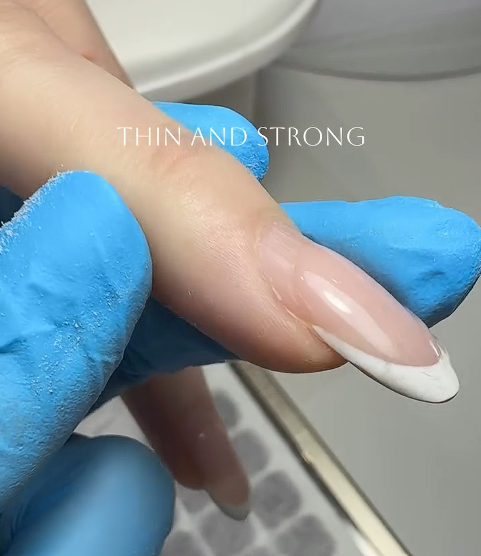
Your first goal should not be creating the most impressive nails in the room.
Your first goal should be learning how to apply product cleanly and safely.
That means working on things like:
controlling your product
keeping product away from the skin
creating an even application
understanding correct structure
improving your brush control
preventing unnecessary bulk
creating a smooth finish
These skills may look simple, but they form the foundation of almost everything else you will learn.
Once you can control your product, more advanced techniques become much easier.
Learn Basic Nail Structure
A beautiful nail also needs to be structurally sound.
When working with builder gel or hard gel, you are not simply painting product onto the nail.
You are creating shape and structure.
That includes understanding areas such as the apex, sidewalls, free edge and overall balance of the nail.
Good structure helps create a nail that looks better, feels better and performs better.
It is also one of those skills that improves with repetition.
Do not expect to create the perfect structure on your first attempt.
Look at each set as practice.
Learn Filing and Shaping
Shaping can completely change the appearance of a finished nail.
Even a beautiful application can look uneven if the shape is inconsistent.
Start with simple shapes and focus on symmetry.
Learn how to look at the nail from different angles rather than only looking directly from above.
You want to check:
the side profile
the free edge
the sidewalls
the thickness
the overall balance
And remember: filing is not about removing as much product as possible.
It is about refining the shape you have already created.
Do Not Rush Into the E-File
An e-file is an incredibly useful tool for nail technicians, but it should be treated as exactly that: a professional tool.
Before focusing on speed, learn control.
You should understand:
different e-file bits
safe speeds
correct pressure
direction of movement
how to keep the bit moving
where you should and should not work
how to avoid damaging the natural nail or surrounding skin
Beginners often want to become fast very quickly.
But accuracy and safety should always come first.
Speed develops naturally as your confidence grows.
Learn Safe Removal and Infill Techniques
Learning how to apply product is only half the process.
You also need to understand what happens when the client comes back.
That means learning how to safely remove, rebalance or infill the product.
Removing too much product or over-filing the natural nail can cause unnecessary damage.
This is why removal should never be treated as an afterthought.
A good nail technician understands the entire service cycle, not only the initial application.
Practise One Skill at a Time
This is probably one of the most useful things you can do as a beginner.
Do not try to perfect preparation, shaping, nail art, product application and speed during the same practice session.
Pick one thing.
For example:
Today I am focusing on getting my cuticle area cleaner.
Or:
Today I am focusing on making every nail the same shape.
Or:
Today I am practising product control.
When you break your learning into smaller pieces, it becomes much easier to see progress.
Ready to Start Learning Nails?
If you've been watching nail videos, saving inspiration and wondering whether you could actually learn to do it yourself, this could be your sign to stop watching from the sidelines.
The Tips n Winks BIAB & Hard Gel + E-File Manicure Online Course is designed to help you build your knowledge and practical skills step by step, so you can learn from home and practise at your own pace.
You don't need to know everything before you begin.
You just need to begin.
Your First Sets Do Not Need to Be Perfect
This is worth repeating.
Your first sets will probably not look like the work you see from nail technicians who have been doing nails for five or ten years.
That does not mean you are doing badly.
It means you are learning.
Every nail technician has created uneven nails.
Every nail technician has taken far too long to finish a set.
Every nail technician has had moments where something just would not cooperate.
The difference between the beginner and the experienced nail tech is usually practice.
What Should You Learn After the Basics?
Once you feel more confident with the foundations, you can start expanding your skills.
That might include:
more advanced builder gel techniques
extensions
different nail shapes
French designs
nail art
more advanced e-file techniques
working faster
working on different nail types
troubleshooting difficult retention issues
There will always be something new to learn.
That is one of the things that makes the nail industry so interesting.
But the more solid your foundation is, the easier those new skills become.
Start With the Basics. Build From There.
If you want to become a nail tech, you do not need to know everything before you begin.
You simply need to learn things in the right order.
Start with nail health.
Learn good preparation.
Understand your products.
Practise clean application.
Learn structure, filing and safe removal.
Then keep building.
The goal is not to become the fastest or most advanced nail technician overnight.
The goal is to develop skills you can rely on.
If you are ready to start learning, the Tips n Winks BIAB & Hard Gel + E-File Manicure Online Course takes you through the techniques and knowledge you need step by step, so you can build your skills from the foundations up.
Because good nail work does not start with nail art.
It starts with strong fundamentals.