BIAB vs Builder Gel vs Hard Gel: What’s the Difference for Beginners?
If you are just starting to learn nails, there are a few words you will hear almost immediately:
BIAB. Builder gel. Hard gel.
Then you start researching and somehow become even more confused.
Are BIAB and builder gel the same thing?
Is hard gel a type of builder gel?
Which one is stronger?
Which one should a beginner learn first?
And why does everyone seem to use these words slightly differently?
If that sounds familiar, you are definitely not alone.
Let’s break it down without making it unnecessarily complicated.
First: BIAB Is a Builder Gel
This is probably the most important thing to understand.
BIAB™ stands for Builder In A Bottle™ and is a trademarked product range created by The GelBottle.
So BIAB is not an entirely separate nail system sitting alongside builder gel.
It is a type of builder gel.
The term has become so commonly used in the nail industry that you will sometimes hear people use “BIAB” when they are actually talking about builder gel in general.
Think of it like this:
Builder gel = the wider product category.
BIAB = a particular Builder In A Bottle product range.
The GelBottle currently offers several BIAB formulations for different purposes, including soak-off and file-off options.
So What Is Builder Gel?
Builder gel is a gel product designed to add more structure and strength than a standard gel polish.
Instead of simply applying colour to the surface of the nail, you can use builder gel to create structure over the natural nail.
Depending on the particular product, it may be used for things such as:
strengthening natural nails
creating overlays
building an apex
repairing broken nails
adding a small amount of length
creating extensions
Builder gels also come in different viscosities.
Some are thinner and self-level quickly.
Others are thicker and give you more control while creating structure.
They can also come in a bottle with a built-in brush or in a pot that you apply using a separate gel brush.
This is why saying “builder gel” does not automatically tell you everything about the product.
You still need to understand the individual system you are using.
What Is BIAB?
BIAB stands for Builder In A Bottle.
As the name suggests, it gives you a builder product in a bottle, usually with a brush similar to a gel polish bottle.
For beginners, that format can feel familiar because you are not immediately working from a pot with a separate brush.
BIAB products are commonly used to create structured overlays over natural nails, adding strength while allowing the technician to create an apex and improve the overall structure of the nail.
The original BIAB formulations are particularly associated with short to mid-length natural nail overlays, although The GelBottle now offers several different BIAB formulas for different nail lengths and services.
But this is where an important lesson comes in:
Do not assume that every product labelled as a builder behaves exactly the same way.
Different formulations can require different base products, different application techniques and different removal methods.
Always learn the system you are actually working with.
What Is Hard Gel?
Hard gel is another gel system used to create strong, structured nail enhancements.
It is generally more rigid than soak-off builder gels and is particularly useful when more structure, strength or length is required.
Hard gel may be used for:
structured natural nail overlays
longer nails
sculpted extensions
strengthening enhancements
repairs
clients who need more support from their nail enhancement
Traditional hard gel is normally a file-off system rather than a soak-off system.
That means removal and maintenance require correct filing technique.
This is one reason learning safe filing and e-file techniques becomes particularly important when working with hard gel.
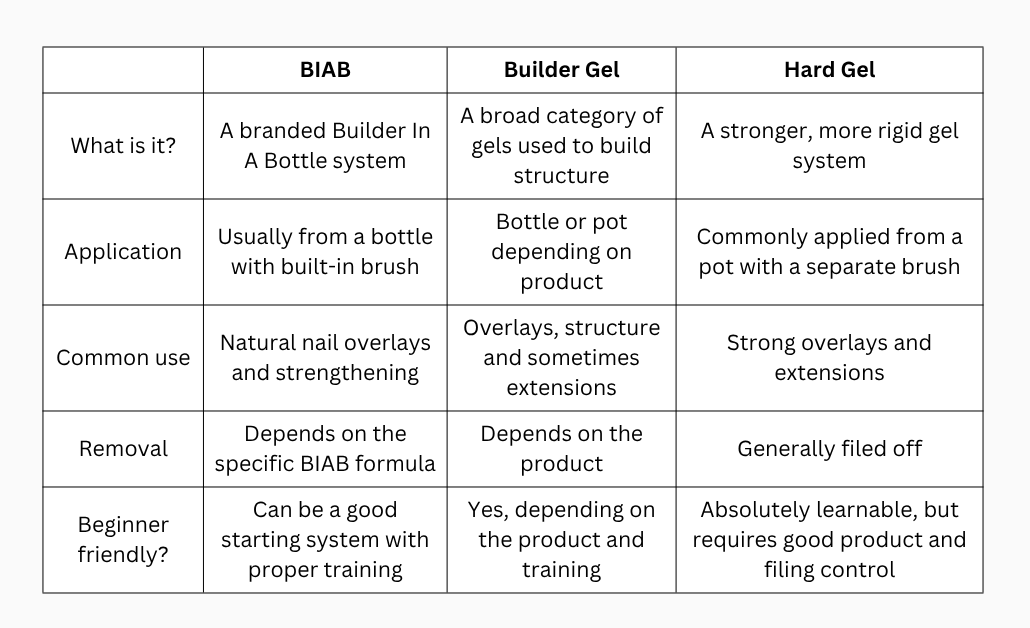
BIAB vs Builder Gel vs Hard Gel at a Glance
Here is the easiest way to think about it:
Which One Is Stronger?
This is where beginners often want one simple answer.
Unfortunately, nails rarely work that way.
Hard gel is generally chosen when you need greater rigidity, length or structural support.
But that does not automatically mean hard gel is the best product for every client.
A short natural nail may not need the same product as a long extension.
A very flexible natural nail may behave differently underneath a rigid enhancement.
A client who wants to grow their natural nails may need something different from a client wanting dramatic extensions.
Choosing a product should not simply be:
“Which one is strongest?”
A better question is:
“Which product is appropriate for the nail and service I am creating?”
That is the type of thinking you want to develop as a nail technician.
What Should a Beginner Learn First?
If you are completely new to nails, do not worry about trying to master every gel system immediately.
Start by learning the principles that apply across your services.
That means understanding:
natural nail preparation
nail anatomy
product control
correct curing
keeping uncured product away from the skin
building structure
apex placement
shaping
filing
removal
infills and maintenance
Once you understand those foundations, learning different products becomes much easier.
Instead of simply memorising:
“This is how I apply this bottle.”
You start understanding:
“This is why I am placing the product here.”
That knowledge is far more valuable.
Do You Need to Learn Both Builder Gel and Hard Gel?
If you are planning to work professionally as a nail technician, understanding more than one system can eventually make you much more versatile.
Different clients have different nails.
Different clients also want different results.
One client may want a natural-looking overlay on short nails.
Another may want to grow their nails longer.
Another may need a repair.
Another may want extensions.
Knowing how different products behave means you can make better decisions instead of trying to use the same product for every person who sits at your desk.
But again: you do not have to learn everything on day one.
Build your skills progressively.
Is Builder Gel Just Thick Gel Polish?
No.
This is another misconception beginners can easily pick up online.
Gel polish is primarily designed to provide colour.
Builder products are designed to allow you to create additional strength and structure.
That structure matters.
When you are learning builder gel, you are not simply learning how to paint a thicker layer onto the nail.
You need to understand things like:
where the nail needs additional product
how to create an apex
how to keep your application balanced
how to avoid unnecessary bulk
how to properly cure your product
how to refine your finished structure
That is why proper builder gel education goes much further than watching someone apply a pretty nude colour.
What About Builder Gel in a Bottle?
You will see lots of brands selling products described as things like:
builder in a bottle
bottle builder
brush-on builder
These products may fall within the wider builder gel category, but they are not automatically BIAB™.
BIAB™ is The GelBottle's specific product name.
This distinction is useful to understand as a nail tech because different brands can have very different instructions.
Just because two products look similar in the bottle does not mean you should apply, cure or remove them in exactly the same way.
Follow the instructions for the professional system you are using.
Which Is Best for a Beginner?
There is no single product that every beginner should use.
A bottle builder can feel approachable when you are first learning because the application format feels familiar.
But the bottle does not teach you nail structure.
It does not teach you product control.
And it does not automatically make the service safe.
Likewise, hard gel may initially feel more advanced, but it is absolutely something you can learn when it is taught properly.
The best beginner product is one that you have been properly taught how to use.
Do Not Choose Your Nail Education Based Only on What's Trending
BIAB manicures have become incredibly popular, which means beginners naturally want to learn them.
There is nothing wrong with that.
But trends should not replace foundations.
If you understand preparation, nail structure, product application, curing, filing and removal, you are building skills that can transfer between systems.
Products will change.
Brands will release new formulas.
Trends will come and go.
The fundamentals of good nail work are what allow you to adapt.
Learn the Product — But Understand the Nail
When you first enter the nail world, all the terminology can make it sound much more complicated than it needs to be.
Remember:
BIAB is a type of builder gel.
Builder gel is a wider category of products used to add structure and strength.
Hard gel is a stronger, generally file-off gel system commonly used when more structure or length is required.
But becoming a good nail technician is not about knowing which buzzword is currently trending.
It is about understanding what you are putting on the nail, why you are using it and how to apply it safely.
The Tips n Winks BIAB & Hard Gel + E-File Manicure Online Course teaches you the techniques behind BIAB, hard gel and e-file manicures so you can understand the process rather than simply copy it.
Because once you understand the foundations, choosing between different products becomes a lot less confusing.
Ready to Start Learning Nails?
If you've been watching nail videos, saving inspiration and wondering whether you could actually learn to do it yourself, this could be your sign to stop watching from the sidelines.
The Tips n Winks BIAB & Hard Gel + E-File Manicure Online Course is designed to help you build your knowledge and practical skills step by step, so you can learn from home and practise at your own pace.
You don't need to know everything before you begin.
You just need to begin.