Why Overfiling Can Make Natural Nails Thin and Weak
Have you ever removed your gel or nail enhancement and thought:
Why do my natural nails suddenly feel so thin?
Maybe they bend more easily than they used to.
Maybe they feel sensitive.
Maybe you can actually see a difference between the older part of the nail and the fresh nail growing near the cuticle.
It can be tempting to blame the gel, BIAB or hard gel itself.
But very often, the problem is not simply that you were wearing a nail enhancement.
It is how the natural nail was prepared or how the product was removed.
One of the biggest culprits?
Overfiling.
What Is Overfiling?
Overfiling happens when too much of the natural nail plate is removed during preparation, maintenance or product removal.
A nail file and an e-file are designed to remove material.
That is exactly what makes them useful.
But once you have removed the product you intended to remove, continuing to file means you may start removing layers of the natural nail underneath.
The natural nail plate may look solid, but it is made up of many compacted layers.
If too many of those layers are filed away, the nail becomes thinner.
Professional nail education sources warn that aggressive filing with coarse abrasives or incorrect e-file use can remove a significant portion of the nail plate surprisingly quickly.
More Filing Does Not Mean Better Prep
This is an important lesson for beginner nail techs.
You do not need to aggressively rough up the natural nail to make your product stick.
Your goal during preparation is not to make the nail thinner.
It is to correctly prepare the surface according to the product system you are using.
That may include:
removing non-living tissue from the nail plate
cleansing the nail
removing surface shine if required by your system
preparing the free edge
making sure the nail is ready for product application
It should not involve repeatedly grinding into the same area of natural nail.
In fact, an overly thinned nail can become more flexible, which may actually contribute to adhesion problems rather than solving them.
Your File Grit Matters
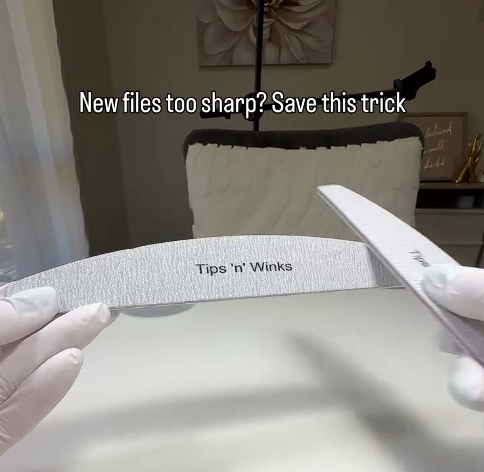
One of the first things nail techs should learn is that different files have different jobs.
The lower the grit number, the coarser the abrasive.
A coarse file removes material faster.
That can be useful when you are reducing the bulk of an existing enhancement.
But a file that is appropriate for removing hard gel or reducing product is not necessarily appropriate for filing directly on the natural nail.
So remember:
Removing product and filing the natural nail are not the same thing.
You might begin removal with a coarser grit to reduce product efficiently.
But as you get closer to the natural nail, your technique, pressure and abrasive choice need to change.
Knowing when to stop is just as important as knowing how to file.
Overfiling Can Happen During Removal Too
Preparation is not the only time natural nails can be damaged.
Removal is another big one.
Imagine you are filing off a builder gel or hard gel service.
At first, there is plenty of product between your file and the natural nail.
As the product becomes thinner, your margin for error becomes smaller.
If you keep filing with the same pressure, speed and abrasive once you reach the natural nail, you can start removing nail-plate layers too.
That is why professional removal is not simply:
“File until everything is gone.”
You need to recognise what you are looking at and understand the product system you are removing.
Sometimes leaving a very thin layer of correctly adhered product may be safer than aggressively chasing every last invisible trace with a file, depending on the system and service you are performing.
Your E-File Is Not the Problem
E-files sometimes get a bad reputation because people associate them with damaged nails.
But an e-file is simply a tool.
Used correctly, it can make nail services efficient and precise.
Used incorrectly, it can remove product — and natural nail — very quickly.
The important factors include:
choosing the correct bit
understanding what that bit is designed for
controlling your speed
using appropriate pressure
keeping the bit moving
understanding your angles
knowing when you have reached the natural nail
You should never rely on pressure to make your e-file “work harder.”
And if you feel like you need to keep going over the same area again and again, stop and assess what you are doing.
Signs a Nail May Have Been Overfiled
Overfiled nails can look or feel different depending on how much nail plate has been removed.
You might notice:
nails that feel unusually thin
increased flexibility
tenderness or sensitivity
discomfort during filing
increased heat sensation during curing
peeling or splitting
visible areas where the nail looks thinner than the new growth
discomfort when pressure is applied
A thinned nail plate can also allow heat generated during curing or filing to be felt more intensely by the sensitive tissue underneath.
One obvious warning sign can be a visible difference between an overfiled section and the new nail growing from the cuticle area.
That difference tells you something important:
The natural nail has physically lost thickness.
“My Nails Are Weak After Gel” Does Not Automatically Mean Gel Damaged Them
This is another myth worth clearing up.
Someone may remove their nail enhancement, see thin natural nails and conclude:
“Gel ruined my nails.”
But professionally applied and properly removed nail coatings should not require you to remove significant amounts of the natural nail plate.
Damage is much more commonly associated with things such as:
aggressive preparation
overfiling
incorrect removal
scraping product away
peeling or picking enhancements off
So before blaming the product itself, look at the complete service.
How was it applied?
How was it maintained?
And most importantly, how was it removed?
Can You Fix an Overfiled Nail?
You cannot simply put back the layers of nail that have already been filed away.
If the damage is limited to the nail plate and the nail matrix has not been injured, that thinner section can gradually grow forward and be replaced by new nail growth.
That means your priority becomes protecting the nail while it grows.
And most importantly:
Do not keep filing it.
If the nail is already thin, repeatedly buffing it in an attempt to “smooth it out” can make the problem worse.
Should You Put Product Over an Overfiled Nail?
This depends on the condition of the nail.
A slightly compromised nail is very different from a nail that is painful, severely thinned, separating from the nail bed or showing signs that something else may be wrong.
As a nail technician, knowing when not to perform a service is part of your job too.
If you see significant pain, inflammation, nail separation, suspected infection or another condition outside your professional scope, stop and recommend that the client seek appropriate medical advice rather than attempting to cover the problem with product.
Your job is not just to make the nail look beautiful.
It is to protect the integrity of the natural nail underneath.
More Pressure Is Not More Professional
Beginners sometimes assume that experienced nail technicians file quickly and aggressively.
What you are actually seeing is control.
A skilled nail tech knows:
how much product needs to be removed
which file or bit to use
how much pressure is required
what the surface should look like
when to move on
and when to stop
Speed comes later.
Accuracy comes first.
If you are still learning, slow down.
You do not get bonus points for removing product faster if you also remove part of the client’s natural nail.
One of the Most Important Skills Is Knowing When to Stop
This applies to both hand filing and e-file work.
When you are removing colour or bulk product, your abrasive can do a lot of the work for you.
But as you move closer to the natural nail, you need to adjust.
Less pressure.
More control.
The correct abrasive.
And a clear understanding of what you are looking at.
You do not need to file the natural nail until it looks perfectly smooth and brand new.
And you certainly do not need to remove nail-plate layers to prove that you have completed a thorough service.
Sometimes the most professional thing you can do is simply stop filing.
Healthy Nails Are the Foundation of Good Nail Work
Beautiful builder gel, BIAB or hard gel work should never come at the expense of the natural nail underneath.
As a beginner nail tech, learning application is exciting.
But learning safe preparation and removal is just as important.
You need to understand your files.
You need to understand your e-file.
You need to understand pressure.
And you need to learn how to recognise the difference between enhancement product and the natural nail underneath it.
The Tips n Winks BIAB & Hard Gel + E-File Manicure Online Course teaches you the process step by step so you are not simply learning how to make nails look beautiful.
You are learning how to work with them responsibly.
Because becoming a great nail tech is not about how much you can file away.
It is knowing exactly what needs to be removed — and what needs to be protected.
Ready to Start Learning Nails?
If you've been watching nail videos, saving inspiration and wondering whether you could actually learn to do it yourself, this could be your sign to stop watching from the sidelines.
The Tips n Winks BIAB & Hard Gel + E-File Manicure Online Course is designed to help you build your knowledge and practical skills step by step, so you can learn from home and practise at your own pace.
You don't need to know everything before you begin.
You just need to begin.